Brest Fortress
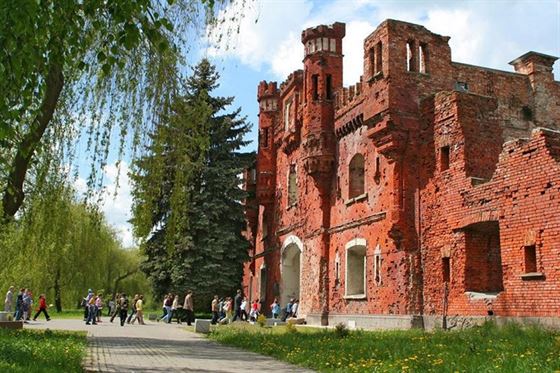
The Brest Fortress is one of the landmarks of Brest and Belarus.
In 1833, according to the project of Karl Opperman, the construction of the fortress started in the centre of the old town. During the construction the Russian authorities destroyed nearly the whole old city, and Brest was moved a few kilometers eastwards.
On April 26, 1842 the construction of the fortress was completed. It consisted of a citadel and three fortifications with a total area of four square kilometers.
In 1864-1888 the fortress was modernized and surrounded by a ring of forts (32 kilometers in diameter). The work on the second ring of fortifications was interrupted by the First World War. Since the beginning of the war the Brest Fortress was preparing for defense, but at night on August 13, 1915, during the general retreat, it was abandoned and partially blown up by Russian troops.
On March 3, 1918 in the citadel the Brest peace treaty was signed between Soviet Russia and the Central Powers, led by Germany. Till the end of 1918 the fortress was in the hands of the Germans, and then got under control of the Poles. In 1920, for a short time it was under control of the Red Army. In 1921-1939 the buildings of the Brest Fortress were used by the Polish authorities as barracks, a military supply depot and a prison.
At the beginning of World War II, from 14 to 22 of September, 1939 the Polish garrison led by General Kanstancin Plisoŭski defended the fortress from the Germans. On September 22, 1939 the Red Army entered Brest and attacked the remnants of the Polish garrison in the fortress. On the same day the Polish resistance was broken down and a joint German-Soviet military parade was held in Brest.
On June 22, 1941 the Soviet garrison of the Brest Fortress came under attack of German troops. About half of the garrison managed to leave the fortress with some items of the military equipment, but the defenders who stayed in the fortress continued to resist for a month.
20 years after the end of the Second World War, in 1965 the Brest Fortress was awarded with the title "Hero Fortress". A memorial complex was built on the territory of the Brest Fortress in 1969-1971. The memorial starts at the monumental main entrance in the shape of a huge star cut in a concrete block. The focal point of the ensemble is the monument "Courage", a bust sculpture of a soldier, 33.5 meters high. The 100-metre obelisk "Bayonet" can be seen from any point of the fortress. It is connected with the monument "Courage" by rows of tombstones with the names of the Soviet defenders of 1941. The sculptural composition "Thirst" is an image of a Soviet soldier, who leans on an assault rifle and tries to reach out to the river and scoop water with a helmet with his last bit of strength.
Publication date: 26.06.2017.
For convenient navigation through the landmarks, use the FREE mobile program