General information
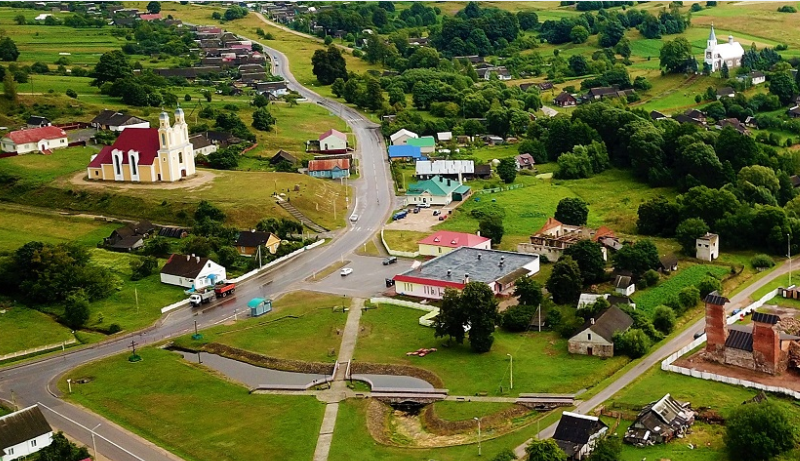
Kreva is a small settlement in the Smarhoń District of the Hrodna Region.
Kreva is a small settlement with an ancient history. The name of this settlement came either from the name of the river (Krevė, Kreŭlianka), or was formed from the name of the tribal community of the Krivichs.
The first written mention of Kreva is in the German chronicles and dates back to the 13th century. In the 1260s, this settlement was part of the Grand Duchy of Lithuania. In the 14th century, Kreva became the capital of the Kreva Principality and a brick castle was built here. In 1338, Grand Duke Hiedzimin gave Kreva to his son Aĺhierd, then Jahaila owned it. In 1382, Grand Duke Kejstut was killed in the Kreva Castle by order of Jahaila.
The greatest fame of Kreva was brought by the signing of the Union of Kreva on August 14, 1385 – an agreement on a dynastic union between the Kingdom of Poland and the Grand Duchy of Lithuania. In 1413, the area became part of the Viĺnia Voivodeship. From the middle of the 15th to the first half of the 16th century, Kreva was the center of the county. On April 7, 1559, Grand Duke Žyhimont Aŭhust granted Kreva Magdeburg rights.
During the war between the Moscow State and the Polish-Lithuanian Commonwealth (1654 – 1667), Kreva was devastated twice (in 1655 and 1659). After the end of the war, the town was restored. In the 18th century, it had several streets: Zareckaja, Piaskoŭskaja, Tatarskaja, Bahdanaŭskaja, Barunskaja. There was a market, 2 taverns, 6 Union churches and 1 Roman-Catholic church.
After the third partition of the Polish-Lithuanian Commonwealth in 1795, Kreva became part of the Russian Empire. In the 19th and early 20th century, the town was one of the major centers of ceramics production. At the end of the 19th century, Kreva had 217 courtyards, 2 churches, a synagogue, a college, a school, 2 shops, and 5 fairs were held regularly. During the First World War, the front line passed near Kreva. As a result, on July 21, 1917, in the course of artillery battles, the walls of the ancient castle and the Roman-Catholic church were destroyed.
In 1920, Kreva briefly became a part of Central Lithuania, and in 1922 – part of the Ašmiany District of the Viĺnia Voivodeship of the Second Polish-Lithuanian Commonwealth. In 1939, with the beginning of the Second World War, Kreva became part of the Belarusian Soviet Socialist Republic and in 1940 it became the center of the village council of the Smarhoń District.
Publication date: 15.07.2024.
For convenient navigation through the landmarks, use the FREE mobile program