Saint Nicholas Church
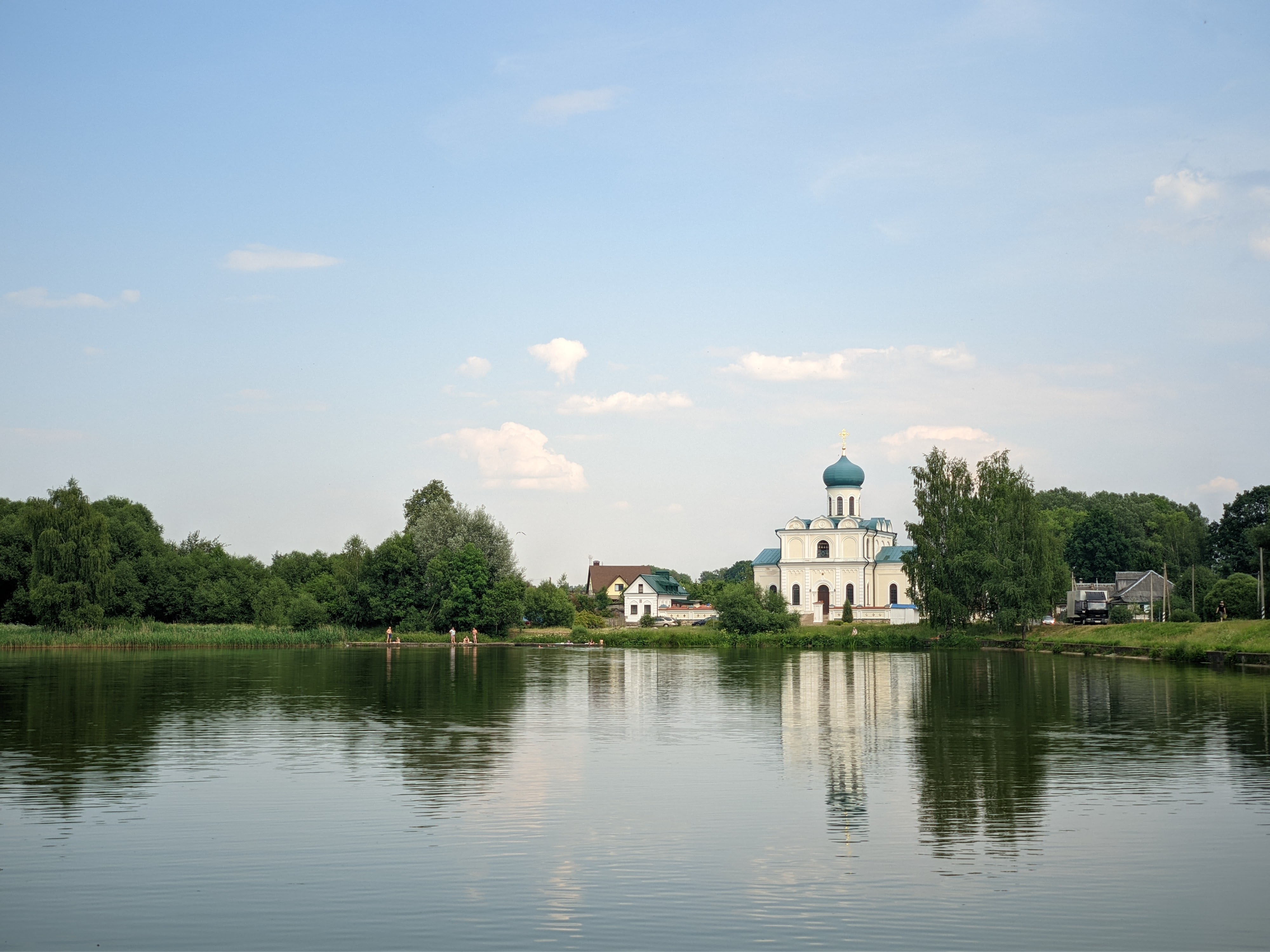
The Orthodox church in the village of Stańkava, Dziaržynsk District, Minsk Region, was built in the 19th century on the foundations of two 18th-century churches (the wooden church built by Prince Radzivil and the Uniate Church of St. Peter and Paul). Located in the center of the village, on the left bank of the Rapusa. The temple is a monument of Russian-Byzantine style architecture.
Visiting record for 1714 shows that a wooden church was built here by Prince Radzivil even before the adoption of the union. Later, the Peter and Paul Uniate Church was built in its place. In the church archive there were 2 books of visiting records from 1732 to 1832, written in Polish. The ruins, which existed in 1961—2011, belonged to the stone Saint Nicholas Church, built in 1858 by the owner of the estate, Count Emieryk Čapski, with the help of parishioners. The church was built on the opposite bank of the river in front of the count's palace. Thanks to the architectural style, the temple was visually included in the general wide and picturesque palace-park ensemble (partially preserved). The church had 3 full-time public schools, thanks to which almost a quarter of the parish population was literate. A stone fence surrounded the church cemetery.
In 1920, the Saint Nicholas Church was closed. All the most valuable things were taken out of it: gold utensils, silver, sacristy, altars, crosses. Some of the icons were burned, but some were hidden and preserved by believers. All the bells were allowed to be remelted, except for the largest one, which could not be removed.
For some time the temple was empty, later it was used as a granary. During the Great Patriotic War, weapons were kept in the walls of the temple. In one of the battles, ammunition was detonated, which damaged the interior of the church. After the war, grain was again stored in the church, but after a severe fire caused by a thunderstorm, it was no longer used for economic purposes.
In March 1961, an old dam broke on the lake. For the construction of a new dam, some buildings of the estate, as well as the Saint Nicholas Church, were destroyed. It was only after the third explosion that the building was partially destroyed. Then, the walls of the temple were pulled apart with the help of tanks and steel cables, and the temple was completely destroyed.
In 1996, the architect Viačaslaŭ Čarnataŭ developed a project for the restoration of the temple, which was carried out until 2011.
Publication date: 05.10.2023.
For convenient navigation through the landmarks, use the FREE mobile program