Saint Andrew the Apostle Church
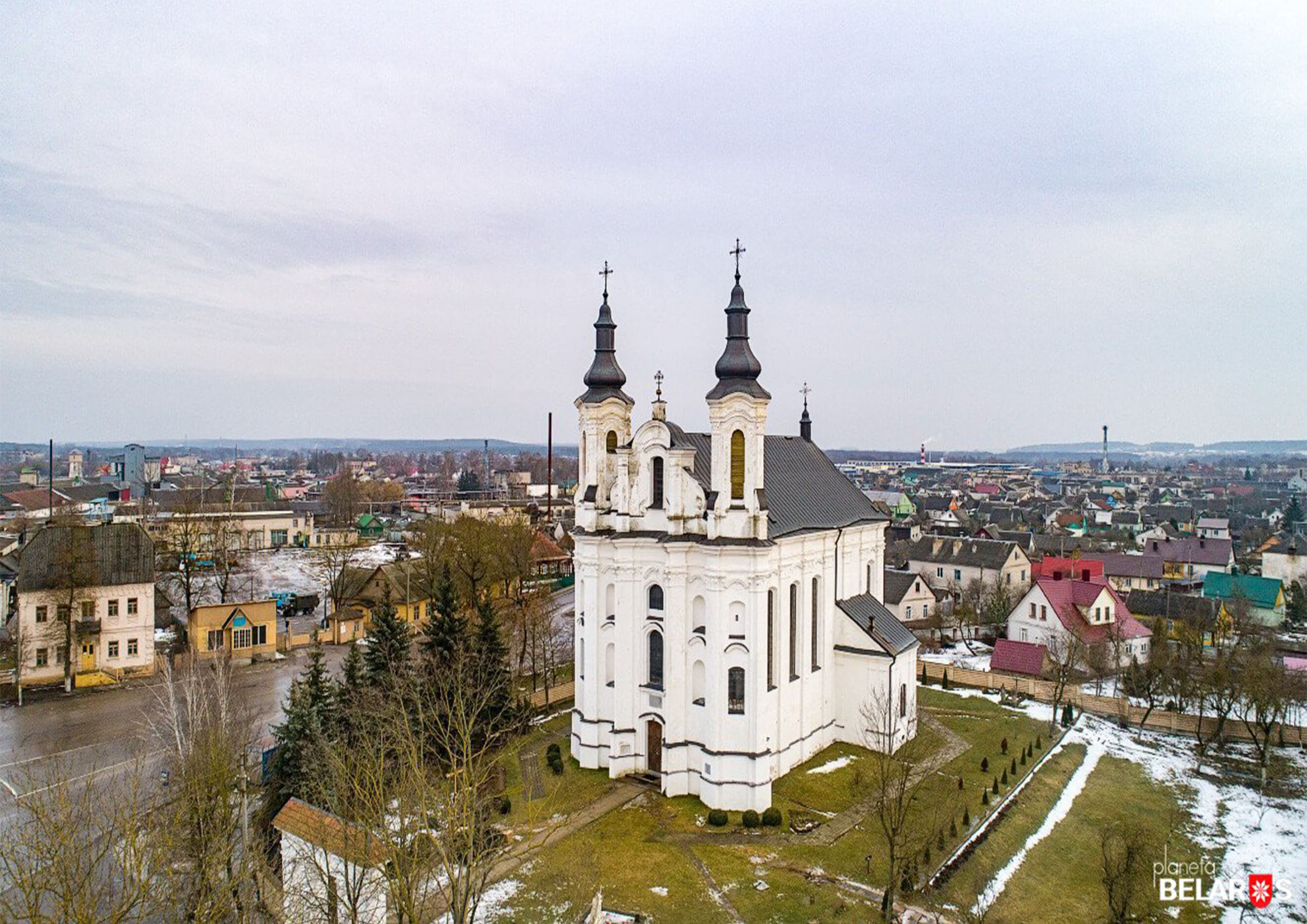
Saint Andrew the Apostle Church is a monument of late Baroque and Rococo architecture. It is located in the eastern part of the city beyond the river, on Lieŭ Sapieha Square. The church is an integral part of the city's panorama.
Saint Andrew the Apostle Church was built in Slonim in 1490 by order of the Grand Duke of Lithuania and King of Poland Kazimir Jahajlavič. The temple was originally wooden. At the end of the 16th century, on the initiative of the famous statesman of the Grand Duchy of Lithuania, Lieŭ Sapieha, the church was restored. Lieŭ Sapieha presented the parish with land on which a hospital, a school and a chapel with a cemetery were built. During the war with the Moscow state of 1654–1667, the wooden church burned down. In 1775, on the initiative and at the expense of the priest-canon Francišak Ancuta and Bishop Hiedrojc of Vilnia, a stone church os Saint Andrew the Apostle was built on the site of the wooden one. At the beginning of the 20th century, frescoes were restored in the church, new terracotta parquet was laid, and an organ brought from Warsaw was installed. After the Second World War, in accordance with the Soviet anti-religious policy, the Catholic church was closed to believers, and the building was used as a warehouse.
In independent Belarus, religious life began to recover, and Saint Andrew the Apostle Church was handed over to believers. After restoration work, it was re-consecrated in 1993. The main decorative elements are concentrated on the main facade. The architectural design of the interior is made in the Rococo style. The architectural complex is complemented by a gate and a one-story monastery building.
Publication date: 16.05.2022.
For convenient navigation through the landmarks, use the FREE mobile program