Winter Garden
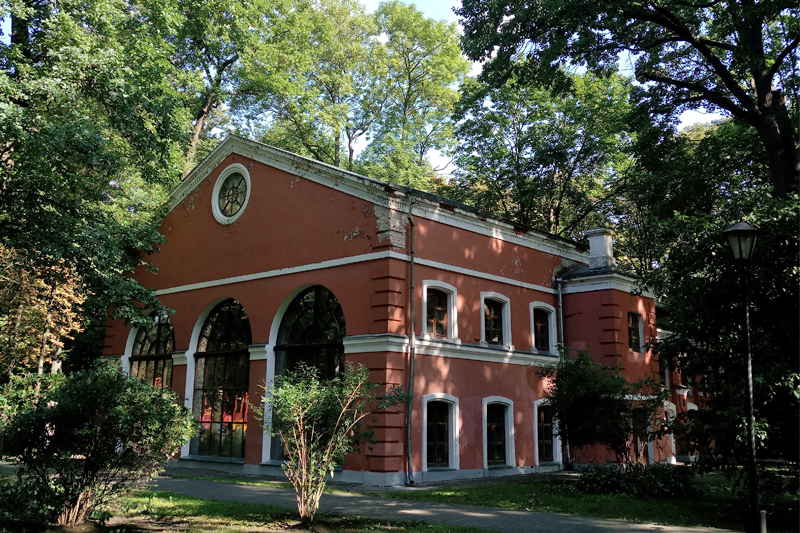
The Winter Garden is an architectural monument of the 19th century and part of the Homieĺ Palace and Park Ensemble of the Rumiancaŭs-Paskievičs.
The building of the Winter Garden was erected in the first half of the 19th century in Homieĺ. Initially, it was used as a sugar factory building, but after a fire in the 1850s, the factory stopped working. However, in 1877, Prince Paskievič began the restoration of the building and turned it into a greenhouse. In winter, the greenhouse of the Paskievičs Princes was heated by two stoves located in the basement.
Inside the walls of the Winter Garden are lined with natural minerals, which allowed climbing plants to cover them with a living green carpet. In 1888, Prince Paskievič planted a rare species of Chamaerops fan palm, which grows in the Winter Garden to this day.
Currently, the collection of the garden includes 18 species of subtropical plants: Magnolia, Chamaerops palm, Euonymus, Coffea tree, Ficus carica, Laurus nobilis, Himalayan Jasminum, Justicia, etc. Besides plants, the Winter Garden has a collection of rare fish, turtles, rabbits, and guinea pigs.
The Winter Garden consists of several rectangular buildings. It is covered with a gable roof, the walls are plastered and painted. The corners of the building are emphasized by the blades scattered around the perimeter. Horizontally, the facade is divided by a ledge and ends with a cornice. The lower volume of the building is decorated with buttresses with decorative trim.
Publication date: 11.11.2021.
For convenient navigation through the landmarks, use the FREE mobile program