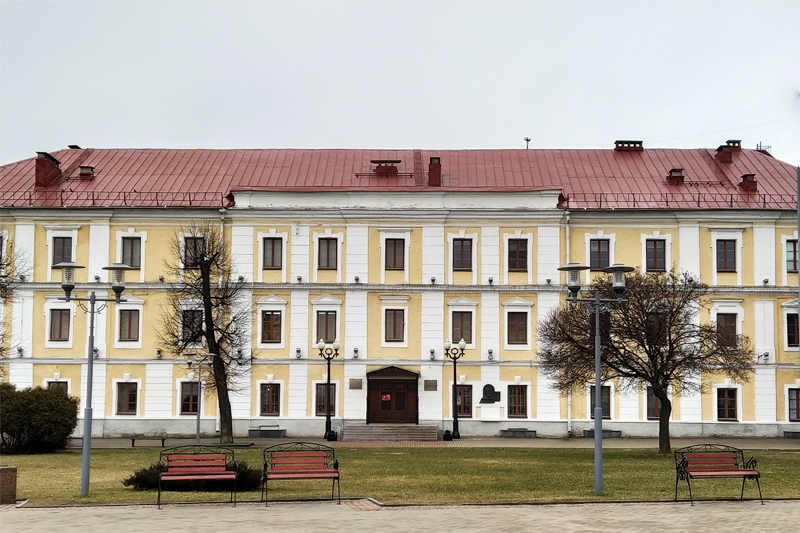
Mahilioŭ Regional Museum of Local Lore named after Jeŭdakim Ramanaŭ
The well-known Belarusian ethnographer, folklorist and archaeologist Jeŭdakim Ramanaŭ is one of the founders of the Mahilioŭ Regional Museum of Local Lore.
The history of museum affairs in Mahilioŭ dates back to November 15, 1867, when the Mahilioŭ Museum was founded under the governorate statistical committee. In 1878, the museum had three departments: historical, ethnographic and geographical. They were based on a collection of agricultural and ethnographic objects. The governorate museum had about 1,500 exhibits. Among them are the privileges of the Grand Dukes of Lithuania and the Kings of Poland Žyhimont III and Stanislaŭ Aŭhust Paniatoŭski, the handwritten Gospel of the 15th century, Napoleon's sleigh and other interesting artifacts.
On December 18, 1904, a solemn opening of the church and archeological museum took place in Mahilioŭ. It was created by the famous Belarusian ethnographer, folklorist and archaeologist Jeŭdakim Ramanaŭ. The first receipts – Bibles, liturgical books, icons, church items – were from monasteries and churches. Some exhibits had a great artistic and historical value. The museum's archive numbered 4,000 units. Most of it consisted of materials from archaeological excavations conducted by Jeŭdakim Ramanaŭ. The museum was located in the building of the former Bernardine Church, which has not survived.
In 1918, the Mahilioŭ and Mahilioŭ Church and Archaeological Museums merged into the one – the governorate, later it would be called "historical". The museum carried out a lot of collecting and research work, in the 20s–30s of the 20th century, the museum had a local lore community, various clubs. In 1928–1929, the Mahilioŭ Historical Museum received valuable exhibits, which were part of the USSR State Antique Fund: objects made of precious metals and stones, icons, paintings, books. The most unique value of this collection was the Jefrasinnia Polackaja’s Cross – the national relic of Belarusians.
During the Nazi occupation, the Belarusian Mahilioŭ Historical Museum on Vulica Lieninskaja and its branch on Vulica Vilienskaja burned down along with the exhibits. The valuables kept in the safe room in the building of the regional administration of the communist party on Vulica Mironava have disappeared, including the Jefrasinnia Polackaja’s Cross. Thus, all museum collections collected during 1867–1941 were destroyed or disappeared.
Only in 1949, the museum resumed its work. The exhibits were provided by the Leningrad and Moscow museums. On January 1, 1951, the first exposition "War and Postwar Construction" opened. In July 1961, the museum received its own three-story building on Savieckaja Plošča. From 1977 to July 1990, the museum was closed for a full repair.
Today, there are more than 20 collections: archeology, numismatics (about 30,000 coins of the Grand Duchy of Lithuania, the Polish-Lithuanian Commonwealth, Moscow State, Prussia, Silesia and other countries), armour suits, crosses of the 16th–17th centuries, weapons of the 14th–19th centuries, printed publications, paintings of the 18th century, documents, phaleristics and so on. Rare exhibits include accessories, a birch-bark manuscript of the 13th century, books of the Mahilioŭ Printing House of 1616–1713, catechisms of the 18th–19th centuries and other unique things.
Publication date: 15.07.2021.
For convenient navigation through the landmarks, use the FREE mobile program