Slavy Square
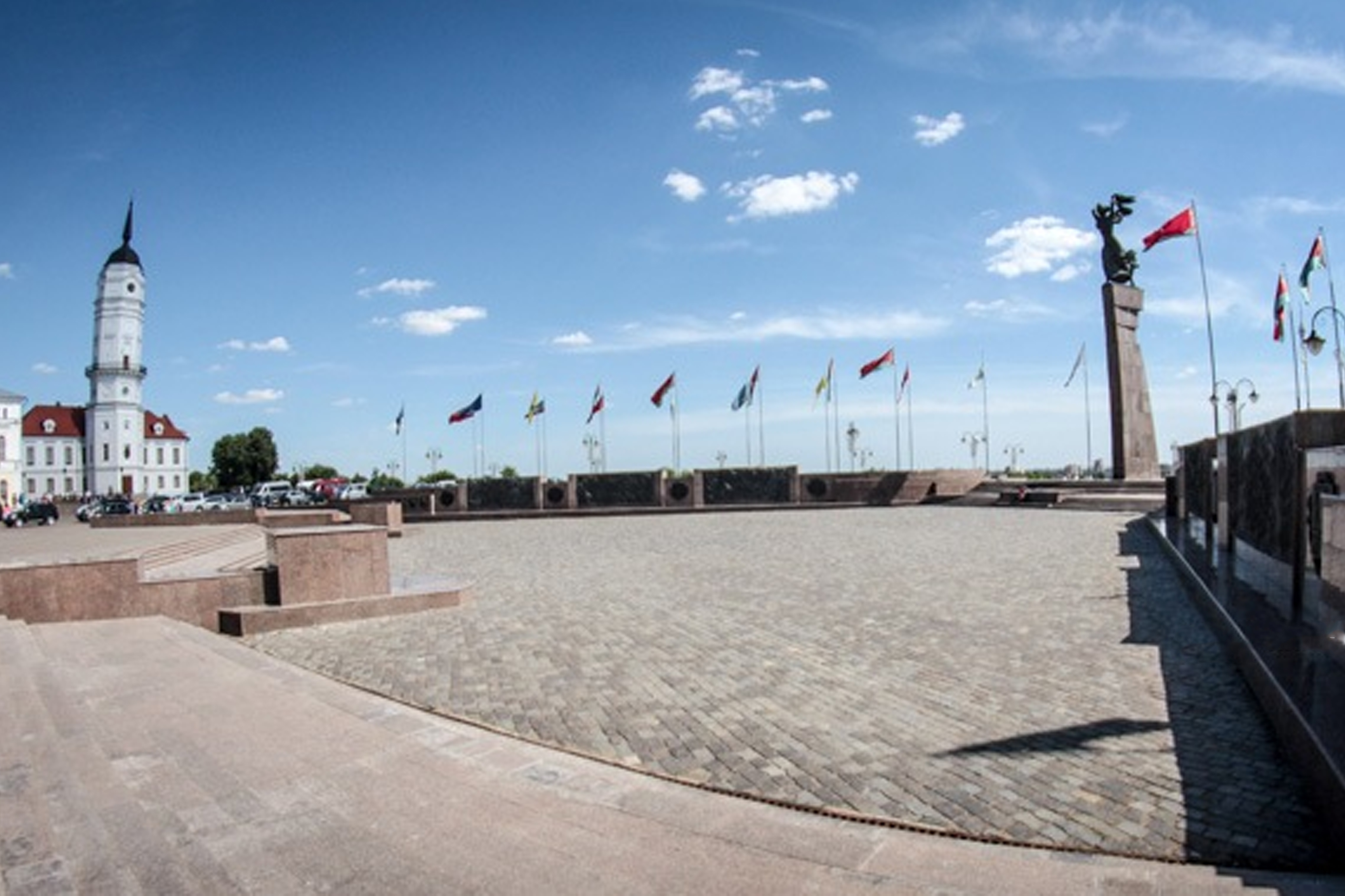
The Slavy Square is one of the main squares of the city, its historical public and administrative center. It represents an architectural ensemble of the 18th – the end of the 19th century.
The square, which was formed in the early 16th century between the castle and the trade and craft Nahorski Pasad, was called Handliovaja. In the second half of the 17th century, a brick city hall was built in the center of the Handliovaja Square. The Handliovaja Square covered an area of more than 2 hectares. It housed 26 shop rows. Two main streets ran radially from the square: Škloŭskaja (now Pieršamajskaja) and Vietranaja (now Lieninskaja), which together with other streets formed a radial plan of the city.
In 1772, as a result of the first partition of the Polish-Lithuanian Commonwealth, Mahilioŭ was incorporated into the Russian Empire and the Handliovaja Square was renamed Hubiernatarskaja. It was rebuilt according to the projects of Russian architects Nikolai Lvov and Vasily Stasov. A new brick ensemble of public buildings was formed on the square. In the eastern part, a governor's house and a provincial government building united by a monumental gate were erected. In the western part, there were the buildings of various provincial administrative institutions. In the southern part on the site of the ancient castle, a city park was laid out. It was finally formed in the late 19th century. In the second half of the 19th century, the city council building was built next to the city hall.
During the Second World War, the ensemble of the square was destroyed. According to the first post-war reconstruction project, the square was included in the recreation area, where traffic was stopped.
In July 1957, the city hall was blown up. And in 1982, in the center of the square, the memorial complex "Fighters for Soviet Power" was erected.
In July 2014, the square received its modern name – "Slavy Square" (in Soviet times it was called Savieckaja).
The modern look of the square was formed in the early 80s of the 20th century. Zamkavy Park adjoins the square from the south and west. From the northeast on the square, there are 5-storeyed apartment houses. Also architectural monuments of the 18th – the second half of the 19th century are preserved: the building of the former district court, which now houses the Mahilioŭ Regional Museum of Local Lore and the building of the former city council. The city hall, restored in 2008, rises on the north side of the square.
Publication date: 01.07.2021.
For convenient navigation through the landmarks, use the FREE mobile program