Braslaŭ hillfort the Castle Hill
The Castle Hill Hillfort, 14 meters high and 2 hectares in area, is an archaeological monument of the IX – XV centuries. It is located in the city centre on the isthmus between lakes Dryviaty and Naviaty.
In 1955 – 1956, an archeological expedition of the USSR Academy of Sciences led by Lieanid Aliaksiejeŭ excavated the castle hillfort. The removal of the lowest cultural layer showed that the settlement on the Castle Hill originated in the IX – X centuries. Spearheads, shards, utensils and tools were found. The ancients of the local places were Balts, and from the XI century, the settlement was inhabited mainly by a mixed Balto-Slavic population. From the late XIV century, when the Braslaŭ Region became a part of the Grand Duchy of Lithuania, a castle and fortified buildings were located on the hillfort.
During the wars of the Grand Duchy of Lithuania with Moscow, the castle was damaged and lost its former significance. In the XVI century, the majority of the population of Braslaŭ lived outside the hillfort, and by the XVIII century most of the hillfort's buildings fell into disrepair.
Back in the early XX century, the area of the Castle Hill was used for economic purposes. During the period when the Western Belarus was part of Poland, the hillfort was bought from private property, fortified and planted with trees. During the Second World War, the hill was a strategic object – up to now there are traces of deepings from the caponiers. In the postwar period, an amusement park was built on the Castle Hill.
Today the hillfort is the second largest in Belarus after the Navahrudak one, as well as the most visited tourist place in the city.
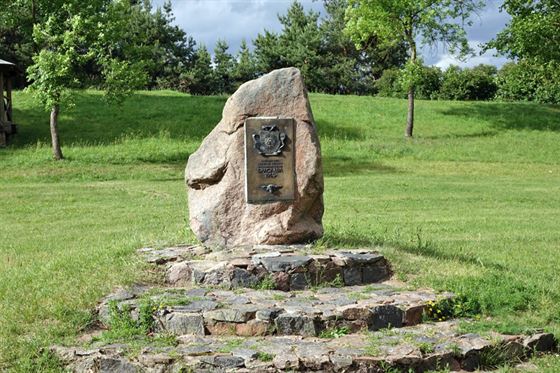
Information stands have been set up on the Castle Hill to tell about the history of Braslaŭ. Nearby, there is a boulder with the image of the coat of arms of the city.
The obelisk in honor of the famous doctor Stanislaŭ Narbut (son of historian Teador Narbut) is the tallest monument on the Castle Hill. He worked in the Braslaŭ Region for about 40 years and died in 1926. The Braslaŭ doctor was buried not in the cemetery, but on the Castle Hill of the city. A high obelisk with a lantern was erected on the funds raised by locals. In 1990, the inscription "Braslaŭ Region is grateful to the doctor" was restored.
Publication date: 09.03.2021.
For convenient navigation through the landmarks, use the FREE mobile program