Navahrudak Castle
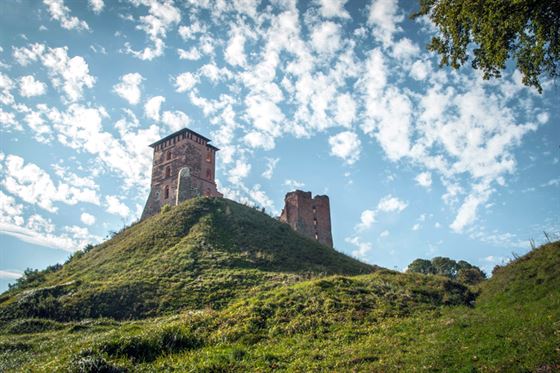
During its existence, the castle was the largest in the territory of modern Belarus. The residence of the grand dukes of Lithuania, Orthodox and Uniate metropolitans, the Tribunal of the Grand Duchy of Lithuania. The possible place of the coronation of Mindoŭh.
The most powerful and largest castle in Belarus once stood on the highest castle hill in the territory of modern Belarus.
The castle appeared in the Ⅺ century on the steep slopes of a partially sprinkled hill, the height of which reached 60 meters. Wooden fortifications of the castle were surrounded by a defensive moat and rampart.
The stone tower-dungeon appeared here only in the XIII century. It played an important role in protecting the castle from frequent attacks by the crusaders.
From the end of the XIV to the middle of the XVI century, another 6 stone towers arose: Kascioĺnaja, Malaja, Pasadskaja, Dazorca, Kalodziežnaja and Miejskaja. Moreover, the latter two formed a special pre-castle fortification – the so-called forburg. There was a water cache in the Kalodziežnaja Tower.
All towers were gradually connected by stone walls of 8 meters high and 2,5 meters thick.
At the same time, the grand ducal palace and the Church of St. Michael, where the sessions of the Tribunal of the Grand Duchy of Lithuania were held, had been built on the territory of the yard.
The castle in its history also managed to be the residence of the Orthodox and Uniate metropolitans. Perhaps it was the site of the coronation of Grand Duke Mindoŭh.
But from the middle of the XVII century, the stone heart of the first capital of the Grand Duchy of Lithuania began to decline. The thirteen-year war of 1654–1667 with the Moscow State caused the greatest destruction. Swedes continued the destruction of the Navahrudak Castle during the Northern War. At the beginning of the XIX century, in 1802, Hrodna governor Bennigsen ordered to dismantle part of the castle towers in order to cobble the streets of Navahrudak.
The castle ruins were taken under protection only in 1921 by the Polish authorities. At the moment, only the remains of two towers, Ščytoŭka and Kascioĺnaja, are preserved.
Publication date: 23.02.2021.
For convenient navigation through the landmarks, use the FREE mobile program