Dominican monastery buildings
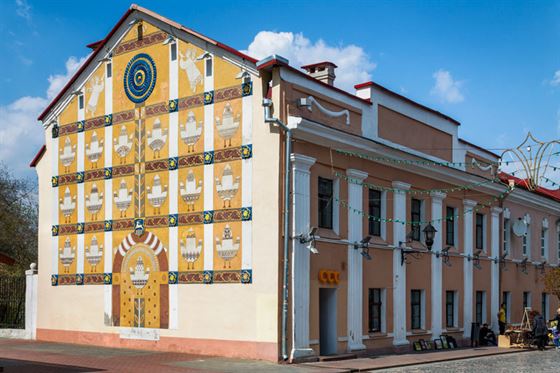
A Dominican monastery in Hrodna was located on Vilienskaja, and then on Daminikanskaja street. Only two monastery buildings on Savieckaja Vulica, 6 and 8 have survived to this day. They provide a real opportunity to imagine the rich cultural and social past of Hrodna.
In the middle of the 17th century, the church and the monastery of the Dominican Order were erected on Vilienskaja Vulica at the expense of Fryderyk and Kryscina Sapieha. As a result, the street became known as Dominican. Two buildings of the former monastery have survived to our days.
A Dominican school-gymnasium was operating at the monastery since the 17th century. The building of the gymnasium was two-story, complex in plan, covered with a gable roof, the walls were plastered. Today the building has the address Savieckaja Vulica, 6.
Since 1834, the Hrodna Provincial Male Gymnasium operated in the building. Since 1926, a female gymnasium named after Emilija Pliater, a male teacher's seminary, and a bookstore worked here. From the autumn of 1939 to the beginning of the Nazi occupation, the building housed the secondary school № 11. At the beginning of the 50s of the XX century, there was a meat processing plant's sausage shop. Then the structure was converted into a residential building. Today trade enterprises are located here.
The building has a memorial plaque to Jonas Jablonskis, a teacher and compiler of the first Lithuanian grammar, who taught Latin and Greek at the male gymnasium in 1912–1914. There is also a memorial plaque to the composer and poet, honorary citizen of Hrodna, honored cultural worker of the BSSR Aliaksandr Šydloŭski, who lived and worked in this house in 1960–1995.
The second structure is the former monastery building (Savieckaja Vulica, 8). In 1789 the building was reconstructed and received the name "New Dominican School". It was a two-story building covered with a gable roof. The walls were plastered and finished with a cornice. The main facade was designed in the baroque style.
During the 19th century, the architectural monument was used as a school building. After the liquidation of the monastery, it housed a women's boarding house and the Maryinskaja Women's Gymnasium. From the end of the 19th century, the building housed the city government, the city police department, the jail and the orphan's court. A barracks was located here in the First World War during the German occupation. From 1919 to 1941 the building housed the city magistrate, in 1939–1941 – the Hrodna City Executive Committee. Since 1945 the editorial offices of three newspapers were located in the building, since 1947 – the newspaper shop of the regional printing house, and since 1949 – the House of Folk Art and the regional puppet theater. In 1970, the building housed the city military commissariat, and now it houses the Hrodna Regional Methodological Center of Folk Art.
The exterior of the building has changed little: the attic above the entrance disappeared, only the central part of the balcony on the attic floor remained, and the metal spire above the facade was destroyed. The biggest loss is the destruction of the baroque gates that were used as the entrance to the monastery.
Publication date: 24.08.2020.
For convenient navigation through the landmarks, use the FREE mobile program