Music school building
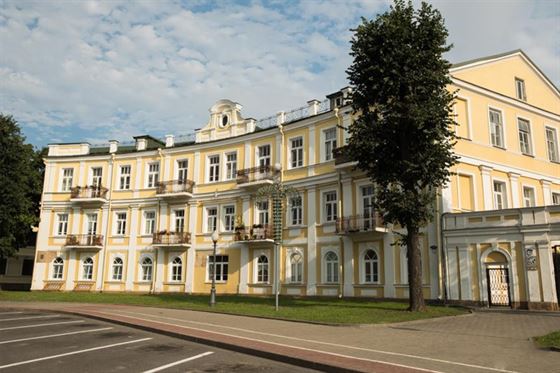
The building of the music school, or the musical outhouse, built in the 70s–80s of the 18th century, is a monument of late baroque architecture.
The building of the music school (the musical outhouse) is a late baroque architectural monument designed by the architect Johannes Möser. The building was part of the Haradnica’s ensemble of Antoni Tyzienhaŭz. It is a two-storey brick building curvilinear in plan with a complex two-tiered roof. The architecture of the building, decorated with arches, pilasters, interfloor belts, is quite complex. The figured roof with a crevice further enhances the expressiveness of the building.
In 1774, a music school was opened in this building, which received the name "kryvaja aficyna". The famous violinist Sitanski became its director. The school was founded as a branch of the Hrodna Tyzienhaŭz Theater. Teachers and families lived on the attic floor, and the first floor was intended for classes with students. The music school in Hrodna existed until 1780. In total, about 40 students received musical education. The level of training was quite high. In addition to musical disciplines, classes in arithmetic and French were held here. In the 80s of the 18th century, the music school was moved to Pastavy.
In the second half of the 19th century, the building of the former music school was sold to the merchant Buĺkaŭštejn. At the beginning of the 20th century, the "kryvaja aficyna" belonged to Duke Drucki-Liubiecki.
Today, the building of the former music school houses the Tyzienhaŭz gallery. Thanks to high-quality restoration, the owners of the gallery managed to preserve the unique theatrical acoustics. Along with exhibitions, the gallery hosts concerts of ancient and classical music.
Publication date: 20.08.2020.
For convenient navigation through the landmarks, use the FREE mobile program