The most historical square in Hrodna
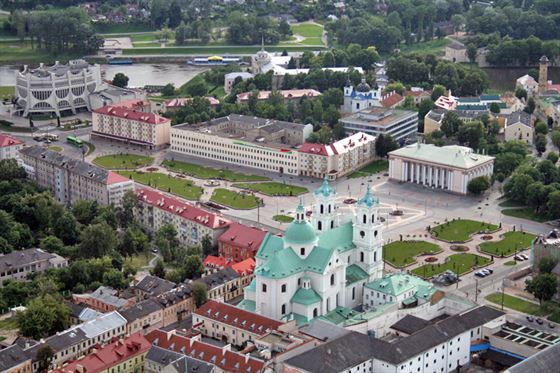
The most historical square in Hrodna is Savieckaja Square – one of the main squares in the central part of Hrodna. It is located at the intersection of Savieckaja, Kirava, Karl Marks, Stefan Batoryj, Mastavaja, Zamkavaja, Kaliučynskaja and Kastryčnickaja streets. Previously, the square was named "Stary Rynak", "Ratušnaja", "Paradnaja", "Sabornaja", "Stefan Batoryj", "Kirkhenplats".
After Hrodna became the possession of the Grand Duke Vitaŭt in 1376, the city experienced an economic boom. In 1389, Vitaŭt founded a wooden church on the western side of the square, and the square itself was connected with the courtyard by Zamkavaja Vulica. A square-shaped market, which became the center of social life and trade, was located on it. In 1513, the Town Hall, the center of the city government, was built on the square.
The next stage in the development of the square is associated with the activities of the king of the Polish-Lithuanian Commonwealth Stefan Batoryj, who made the city his residence. In 1586, instead of the wooden one, a stone church was built, and in 1580, the Stefan Batoryj palace was built on the eastern side of the square.
During the war with Russia in 1654–1667, the city was plundered by Russian troops. The restoration began only at the end of the 17th century, when the Radzivils' palace was built on the southern side of the square, and the palace of Stefan Batoryj was rebuilt into the Bžastoŭskis' palace.
At the beginning of the 18th century, a Jesuit church was built in front of Vitaŭt's Farny Church, and next to it there was the building of a Jesuit pharmacy. Both buildings have remained almost unchanged. The square itself was paved, and a well was dug near the Town Hall.
In 1803, the Russian authorities placed barracks and a prison on the territory of the Jesuit monastery. In 1805, the Vitaŭt's Farny Church was rebuilt into Orthodox St. Sophia Cathedral (rebuilt in the pseudo-Russian style in 1889). In 1807, a square with a fountain was laid between the building of the Town Hall and the south side of the square. The features of the square have survived to this day. In the 1880s, the house of the merchant Muraŭjoŭ was erected in the Art Nouveau style on the northern side of the square.
After the signing of the partition of Belarus between Poland and Soviet Russia in 1921, Hrodna became part of Poland. As a result, Orthodox St. Sophia Cathedral became a garrison church and was rebuilt in the Gothic style.
During the Second World War, the south side of the square was severely damaged. The buildings of the Town Hall and the Palace of the Radzivils were lost. During the Soviet era, the wing of the Stefan Batoryj palace and the buildings on the north side of the square were demolished. In 1958, the Palace of Culture of Textile Workers was built on the western side of the square. And on November 29, 1961, the Vitaŭt's Farny Church was blown up. Nothing has ever been built on its site, and now there is a public garden there.
The square was landscaped in independent Belarus and now it is one of the main landmarks of the city above the Nioman.
Publication date: 20.08.2020.
For convenient navigation through the landmarks, use the FREE mobile program