The elder street of Hrodna
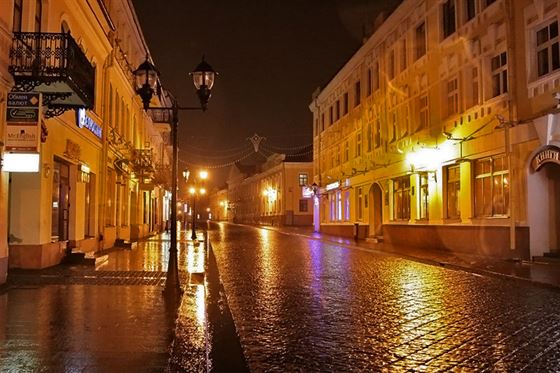
Savieckaja Street (former Vilienskaja, Sabornaja, Daminikanskaja) is one of the oldest streets in Hrodna. The street is pedestrianized and has a great historical value; almost all buildings of the 19th – early 20th centuries have been preserved on it. The length of the street is about 500 meters, from Savieckaja Square to Ažeški Vulica.
The street has been known since the 14th century as a trade route, which in the second half of the 15th century became one of the main streets of the right-bank part of Hrodna. It led from the Hrodna Market to the Vilienski highway and therefore was called "Vilienskaja". At the beginning of the 17th century, the following buildings were constructed on the street: the palace of the Sanhuškas princes, the Sapiehas’ palaces and the palace of the Masaĺskis princes. The architectural appearance of the street was complemented by the Monastery of the Holy Spirit, built by Queen Bona Sforza in the middle of the 16th century, and the Dominican Catholic church with a monastery. Among the architectural monuments of the 18th century, the building of the former male gymnasium built in the classicism style has been preserved.
In 1864, the Russian authorities renamed the street to Safijskaja. In the 70s of the XIX century, only 2-3-storey stone houses, mostly merchant ones, were built on it. During the fire of 1885, most of the buildings were destroyed and seriously damaged.
In the late 19th and early 20th centuries, the street changed its name to Sabornaja, and in the interwar period to Daminikanskaja Vulica. During the Second World War, the street had the name Hindenburg Strasse. During the Soviet period, the street was called Savieckaja.
During the Second World War, the buildings of Savieckaja Vulica were partially damaged, but most of the destruction occurred in the post-war years. In 1949, the general plan for the reconstruction and development of the city of Hrodna was approved. According to the plan, Savieckaja Vulica was to turn into an avenue 30 meters wide. All historical buildings on the even side were subject to demolition. The House of Trade Unions and a general store were built on this side. The developers of the second plan of 1963 went even further. According to this plan, Savieckaja Vulica was to be transformed into a boulevard with two separate lanes. Most of the historical buildings in the central part were subject to demolition. In 1960–1970, a large number of yard outbuildings were demolished, some of the architectural facades were significantly changed.
In independent Belarus, the street was made pedestrian in order to preserve those historical buildings that remained after the Soviet "reconstructions".
Publication date: 20.08.2020.
For convenient navigation through the landmarks, use the FREE mobile program