Hrodna Holy Protection Cathedral
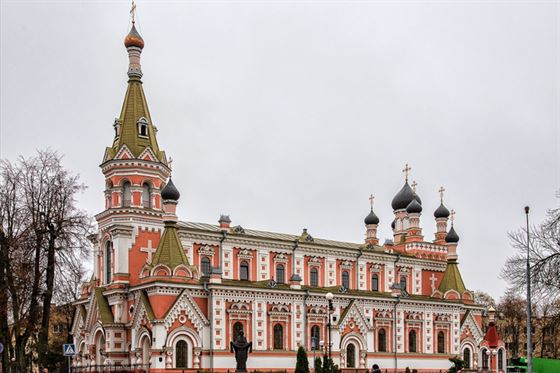
The Hrodna Holy Protection Cathedral was built in memory of the Hrodna garrison soldiers who had died during the Russian-Japanese war of 1904–1905.
Military and civilian specialists built the memorial temple. The project was developed by the Engineering Department of the Viĺnia Military District. The temple was consecrated on September 30, 1907.
After 1921, the building was converted from a garrison church to a cathedral. Under German occupation during the Second World War, services in the cathedral were prohibited on weekdays, and on Sunday they had to end no later than 8 pm. However, Bishop Benedict (Babkoŭski) obtained permission to hold daily services. After the war, the Soviet government, in line with its anti-religious policy, banned the procession and solemn services during religious holidays. In 1962, church belling was banned. However, the authorities did not manage to close the Holy Protection Cathedral, and services were held there regularly.
After the proclamation of independence of the Republic of Belarus, the Hrodna Diocese abolished in 1951 was restored, and the Holy Protection temple became a cathedral again. On the eve of its centenary, the cathedral underwent a major overhaul.
The Holy Protection Cathedral was built in a retrospective Russian style and consists of three naves. There is a 10-meter octahedral bell tower with a dome on the main facade.
Publication date: 20.08.2020.
For convenient navigation through the landmarks, use the FREE mobile program