Stanislavava Estate
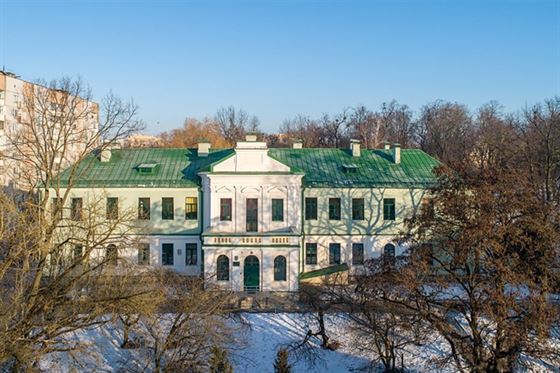
The Stanislavava Estate was built in 1770 in the late Baroque style by the Italian architect Giuseppe de Sacco. It was built for 10 years and was supposed to become the country residence of the last king of the Polish-Lithuanian Commonwealth Stanislaŭ Aŭhust Paniatoŭski. However, the king did not live in it for a long time.
Architecturally, the main estate house is a two-story rectangular building. There were wings on its sides. The central facade is distinguished by a semicircular bay window, on which the royal monogram has been preserved. There were outbuildings near the estate. The estate was surrounded by a park, the main element of which was a linden alley driveway. Several old lime trees that "saw" Stanislaŭ Aŭhust Paniatoŭski have survived to this day. In the second half of the 19th century, this radial park was rebuilt into a landscape park. Its remains have survived to this day.
In 1953 the Stanislavava estate was transferred to the Hrodna Agricultural Institute and rebuilt. In 1982–1983 it was significantly compacted by a number of multi-storey residential buildings. Currently, there are departments of the Hrodna State Agrarian University on the territory of the estate.
Publication date: 11.06.2020.
For convenient navigation through the landmarks, use the FREE mobile program