Children’s Railway
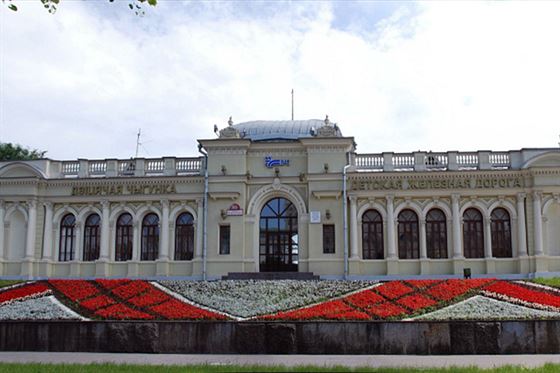
Children's Railway is not only an educational institution, but also a real transport company.
The Children's Railway differs from the large one only in length (4 kilometers) and canvas width – 75 cm, which is half the “adult standard”. However, the main difference is that the machinists, guides, dispatchers here are teenagers.
The history of the Children's Railway in Minsk began on July 9, 1955. This was not the first steel thoroughfare for children in BSSR. Its predecessor appeared in Homieĺ in 1936, but was destroyed during the Second World War. In the post-war period, it was decided not to restore it, but to build a new one in the Belarusian capital.
The narrow-gauge railway, which was built during the German occupation to export timber from the Čaliuskincaŭ park, was taken as the basis for the Сhildren's Railway in Minsk. Since 1955, the steam locomotive Kp, as well as 6 wagons made of wood, ran along the tracks. In 1967, two diesel locomotives with all-metal wagons were already driving along the Children's Railway. In 2005, in honor of the half-century anniversary of the Children's Railway, 6 repaired wagons were presented. And in 2008 a new diesel locomotive was acquired.
The first stations of the Children's Railway were called “Park Kuĺtury” and “Sasnovy Bor”. In 1971, Park Kuĺtury station was renamed in Zaslonava.
The children's railway is open from May to September. There are three stations on it. Zaslonava is the starting and ending station where passengers board and get off. Pijanierskaja is a station with a technical bias, where various equipment, control panels for railway signals and arrows are located. And “Sasnovy Bor” is a stopping point where passengers can get out, enjoy nature and continue their riding on the next train.
In 2009, a training center was opened at the Children's Railway. It contains historical and specialized classes, as well as a fully equipped computer room.
Publication date: 17.02.2020.
For convenient navigation through the landmarks, use the FREE mobile program