City Hall
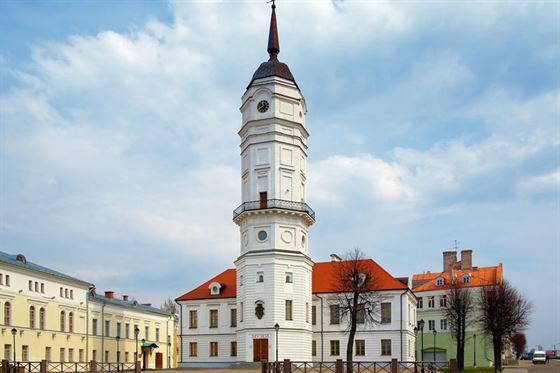
Mahilioŭ City Hall is an architectural monument in the central part of Mahilioŭ, a symbol of the city. It existed in the XVII–XX centuries. In 2008 it was restored.
In 1578, a year after the city received the Magdeburg Law Charter, the construction of the city hall began in Mahilioŭ. Initially, the city hall was wooden, so it repeatedly burned down.
In September 1679, the construction of a brick city hall at Handliovaja Square began. The main building was completed in 1681. The first tower collapsed. A new 8-sided 5-tiered tower 46 meters high was erected in 1692. Together with the bell tower of Epiphany Cathedral, the city hall tower was the main vertical dominant of the city.
During the Great Northern War in September 1708, the city hall burned down, but it was quickly rebuilt. And in 1733, the city hall was completely rebuilt. The building was the tallest in the city.
During the Second World War, the city hall building was badly damaged. On December 28, 1952, at a meeting of architects of the BSSR on the protection of architectural monuments, it was decided to restore it. In 1953, by the decision of the local authorities, the city hall building was given the status of an architectural monument. However, the restoration did not have time to begin, in July 1957, the town hall building was blown up.
In 2008, the rebuilt Mahilioŭ City Hall was inaugurated in independent Belarus.
Today, the city hall is a two-storey brick building with an octagonal five-tired tower in the middle of the main facade. The height of the city hall is 14 meters, the height of the tower is 47 meters 30 centimeters. The facades of the city hall have been restored according to the pattern of the mid-18th century. At the top of the 47-meter tower, there is a unique mechanical clock made by Mahilioŭ clockmaker Hienadź Haloŭčyk. In 2014, a mechanical figure of a city trumpeter appeared on the city hall tower. Hienadź Haloŭčyk was the author of the idea and the executor of the mechanical part of this project, while the Mahilioŭ sculptor Andrej Vierabjoŭ was the author of the art part.
Publication date: 18.05.2017.
For convenient navigation through the landmarks, use the FREE mobile program