Horkis' Park
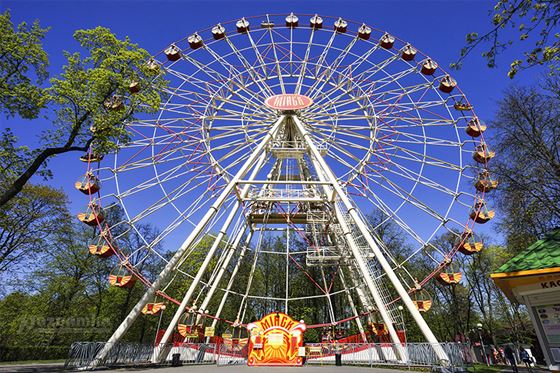
The Central Children's Park named after Maxim Horki in Minsk is a monument of history, architecture and landscape art. Today the park covers an area of about 28 hectares. About 60 species of trees and shrubs — pine, poplar and alder — that were planted in the 19th century, grow throughout the park.
This park first appeared on the plan of Minsk in 1801 and was designated as the "City Garden". At that time, Minsk was under the rule of the Russian Empire. The grand opening of this park took place on May 1, 1805. Initially, the park occupied about 18 hectares. In the Minsk "city garden" there were alleys, flower beds and wild ponds. By the end of the 19th century, the first stadium with a bicycle track was built in it and various game zones were created.
In 1920, when the Communists came to power, the Minsk "city garden" was renamed into the Profintern garden, and in 1936 the name of the Russian Soviet writer Maxim Horki was given to it.
After the end of the Second World War, the park's area increased significantly due to the demolition of buildings destroyed during the war. The stadium that survived the war was streamlined. The first rides and a summer cinema appeared in the park. However, the cinema was burned down in the 1970s.
In 1960, the park acquired its current name - the Central Children's Park named after Maxim Horki. A whole complex of playgrounds was erected here. Also at this time a planetarium was opened in the park.
In the 1970s, the entrance arched gate of the park from the Victory Square was restored. In 1955 and 1981, two monuments to Maxim Horki were erected in the park.
Publication date: 07.06.2019.
For convenient navigation through the landmarks, use the FREE mobile program