Aliaksandraŭski Square
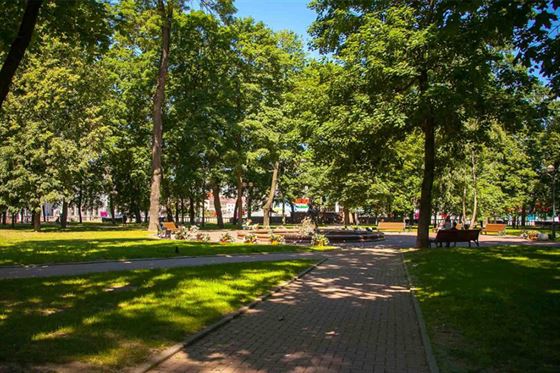
Aliaksandraŭski Square is one of the oldest squares in Minsk, preserved to our time. It got the name from the Aliaksandr Neŭski Orthodox chapel built there in 1869.
In the 1830s there was a wasteland at the site of the square. Later there appeared the Square of Public Places. In the late 60s – early 70s of the 19th century, the boulevard located here began to turn into a square. Over time, it was streamlined and surrounded by a fence. A pedestrian path was laid in the center to the Archiereus Compound.
In the 19th century, the streets Padhornaja (today Karla Marksa Street), Zachar'jeŭskaja (today Niezaliežnasci Avenue), Skobielieŭskaja (today Čyrvonaarmiejskaja), Palicejskaja (today Janki Kupaly) were formed here. Near the square stood the archiereus house, the Orthodox spiritual consistory and the Pakroŭskaja Church (Kryžovaja Church). The walls of the Pakroŭskaja Church, destroyed by the Bolsheviks, served as the framework for the left wing of the District Officers House, which was built here in 1934-1939.
In 1874, a water supply system with clean artesian water began to operate in Minsk. In honor of this event, a fountain with the sculpture "Boy and Swan" was built in the Aliaksandraŭski Square. In 1890, the Minsk City Theater was built in Aliaksandraŭski Square. Now it is a theater named after Janka Kupala.
After the Second World War, in 1955, the square was surrounded by a granite wall on one side, and a metal fence on the other. In 1970, the square was reconstructed and landscaped. Columns, updated benches, granite vases appeared in it, the number of entrances was increased, new flowerbeds and lawns were added, and a tribune was erected. In 1979, a memorial sign was erected in the square on the site of the execution of members of the Minsk underground in 1942.
Publication date: 07.06.2019.
For convenient navigation through the landmarks, use the FREE mobile program