Holy Trinity Church
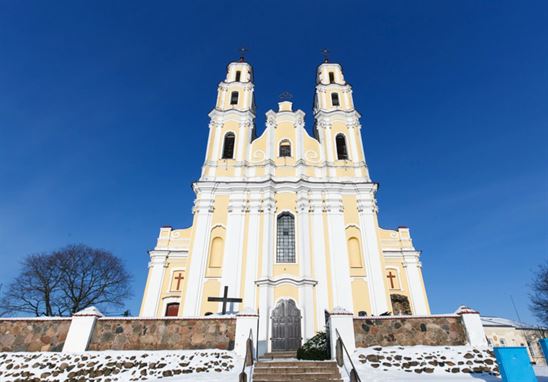
An architectural monument of the late Baroque. Built in 1764–1782 on the site of the wooden one, built in 1628 by Iosif Korsak, burned down during the Thirteen Years' War (1654–1667), when Hlybokaje was attacked by Russian troops. In 1764 the dilapidated church had been dismantled and a stone church in the late Baroque style was built on its site.
An architectural monument of the late Baroque. Built in 1764–1782 on the site of the wooden one, built in 1628 by Iosif Korsak, burned down during the Thirteen Years' War (1654–1667), when Hlybokaje was attacked by Russian troops. In 1764 the dilapidated church had been dismantled and a stone church in the late Baroque style was built on its site.
Initially, the church was a two-towered single-nave basilica with an elongated semi-circular apse. During the rebuilding in 1902–1908 a transept, aisles and a sacristy were built out to the temple, giving the building the composition of a cross-shaped basilica. Two-tier towers grew two more tiers at the same time and became four-tier. Their decorative formation was in the Vilnius style. The main facade of the monument is enriched by rich architectural decoration: sophisticated in drawing pilasters, a cornice broken line, figure arcs of apertures, a tall pediment with currencies and a sculpture "Crucifixion" in the archway.
The interior of the temple is decorated with three different wooden Baroque altars. The central altar in the lower tier – with sculpture drawings of St. Peter and St. Paul. In the center – the icon "Crucifixion". On the second tier – the icon of the beginning of the XVIII century "Mother of God Hodegetria". The high relief composition "Gloria with angels" completes the altar. A portable altar with icons "Mother of God Tenderness" and "Joseph with the Child" (the beginning of the XVIII century), "The Holy Family" (1730s) are also being preserved in the church. Above the entrance there is a choir and an organ in Gothic Revival style.
A crypto, where the sponsor asked to be buried "without ceremony", stretches under the church over the entire width of the temple. His portrait was attached at one of the pillars of the church.
Services did not stop in the temple even during the Soviet era.
Publication date: 16.01.2019.
For convenient navigation through the landmarks, use the FREE mobile program