St. Boris and Gleb (Kaloža) Church
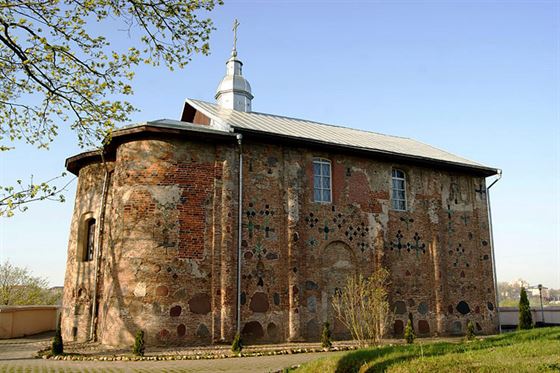
St. Boris and Gleb (Kaloža) Church is an architectural jewel of ancient Hrodna. The temple is a UNESCO World Heritage Site.
The exact date of the temple construction beginning is unknown, but it is assumed that the stone church on the steep bank of the Nioman was built in the 1140s – 1170s. The temple was named after the saint dukes Boris and Gleb. The name "Kaloža" is associated either with Kalažań, or the residents of the local town of Kaloža, who moved here in 1409, after the march of duke Vitaŭt to Pskov.
The great fire of 1184 in Hrodna destroyed the Lower Castle Church, and Boris and Gleb Church became the main church of the city.
Throughout the 14th century, as a result of numerous attacks by the Crusaders, the church fell into decay. And later, during the wars with the duchy of Moscow, it was significantly damaged. However, the main danger for the church that was restored in the 16th century was the force of nature. On the night of April 2, 1853, the southern and part of the western walls, together with the ceiling, collapsed into the Nioman. The landslides of 1864 and 1889 caused further damage. As a result, the church was abandoned for 40 years.
In 1894–1906 the bank on which the church stands was fortified. Lighter wooden walls were built in place of the destroyed stone ones. The temple has survived in this state to this day.
During the Soviet times, Kaloža Church was closed for worship. In 1948 it was transferred to the historical and archaeological museum, and in 1967, together with the Castle Hill, it became part of the Hrodna Historical and Archaeological Reserve. Only in the early 1990s Kaloža Church was returned to the believers.
Boris and Gleb Church is a unique example of ancient stone architecture, built by the masters of the Hrodna architectural school. The church has no direct analogues in the world. Its unique feature is the multiple ceramic pots-resonators built into the wall, thanks to which good acoustics have been preserved here for many centuries.
Another famous feature of Kaloža is the decoration of the facades and walls with inserts of large polished boulders in the form of crosses.
The interior of Kaloža Church was decorated with unique frescoes, fragments of which were found in the 1970s.
Publication date: 12.06.2017.
For convenient navigation through the landmarks, use the FREE mobile program